We have all at some stage picked up a notebook, turned over a few pages and thought 'this one seems nice' even though we don't really know why. In most cases, that 'nice' feeling is due to a single small detail printed somewhere on the cover which we almost never notice: GSM.
You probably know just how much paper quality matters if, whenever you've bought a notebook, your pen has almost ripped through the pages or if you've noticed ink seeping from one side of the paper to the other as you write. It's very annoying, particularly when you're in the middle of an exam and having to take important notes in a lecture or when keeping up your daily business accounts, since in those situations the paper becomes the problem rather than simply being the surface on which you write.
Understanding GSM
GSM is an abbreviation for Grams per Square Meter; in simple terms it indicates the weight of one square metre of the paper. The greater the GSM figure, the thicker and heavier the paper will be, while a lower number means that the paper is thinner and lighter.
That's essentially all it is: just a weight measurement. However, that single figure ends up having an impact on almost every aspect of how the notebook feels and performs when you begin writing in it.
How GSM Affects Your Everyday Writing
This is when it becomes a personal experience. Recall a situation in which you used a gel pen or a pen with slightly wet ink on thin paper; in that case you might have noticed the ink spreading over the following page, or even worse, staining the page below. Moreover, thin paper usually has a fragile feel when you hold it, and the pages are likely to tear if you rub them too hard or turn the notebook too frequently.
A greater GSM weight for the paper deals with both of these issues: it retains the ink better without it bleeding through, it has a more substantial feel when you're writing, and it lasts longer since the pages aren't damaged by ordinary use. For students who are writing huge amounts of notes every day or for shopkeepers and accountants who have to use a register book which has to last for months or years, this isn't a minor point it's the difference between a notebook that serves you well and one that fails halfway through the year.
Why GSM Differs Across Notebook Types
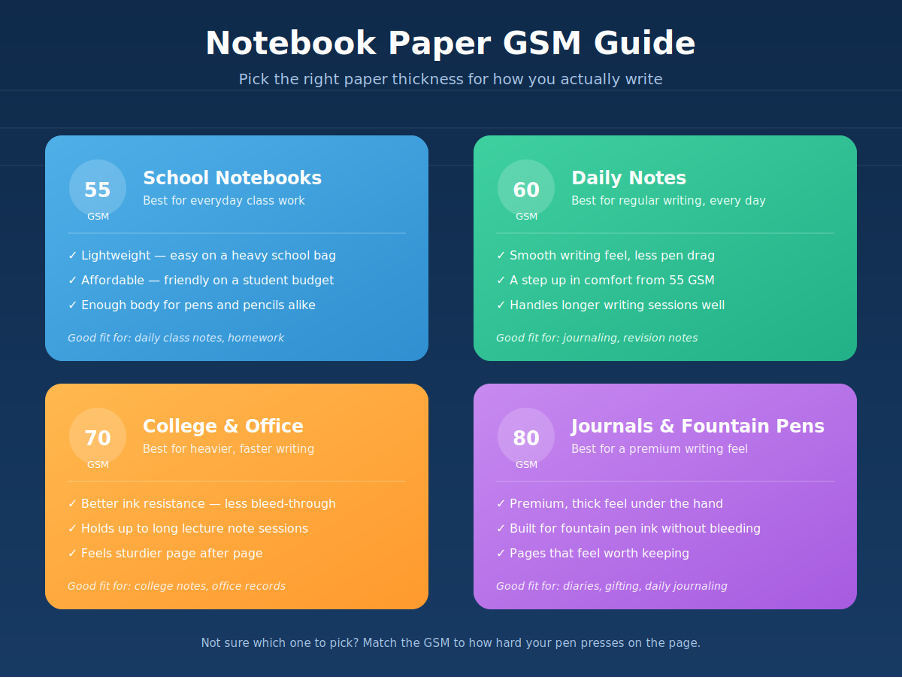
It is not necessary for all notebooks to have the same paper thickness, since this is in fact intended, not a flaw. The appropriate GSM will vary according to the purpose of the notebook. The short and longe size notebooks, which are the kind most students use for taking notes on their subjects, generally have a moderate GSM, typically being about 55 to 70 GSM. This makes the notebooks light weight and cheap for everyday use, while at the same time keeping them thick enough so that writing on them is comfortable without there being constant bleed-through.
Notebooks that are bound in hard covers or in cases, such as diaries, registers and long-lasting record books, generally follow a slightly different method. Since they are intended to be used for months or even years, the paper is usually given an extra surface treatment, for example surface sizing, so that the writing is smoother and less likely to smudge, even if the base GSM is the same as that of a normal notebook. In certain heavy-duty registers, both a thicker board and reinforced binding are just as important as the paper GSM itself since the notebook has to endure constant daily use.
It's not merely a matter of following a single "higher is better" principle; it's about selecting the right type of paper according to the actual way the notebook will be used, including how frequently, for how long and with what kind of writing.
Why GSM Should Matter to You Before You Buy
It's simple enough to go into a shop or browse through an online store and simply choose a notebook on the basis of how its cover looks or how much it costs. However, if at any time you've felt regret about a purchase since the pages were too thin or the ink kept bleeding through as you were making some important notes, then you already understand the reason why GSM should be given some more thought before you buy.
It is advisable to check the GSM when you are buying the paper since this will prevent you from experiencing disappointment. For example, if you are a student who writes a lot each day, then using a paper with a slightly higher GSM will help eliminate the annoyance caused by bleed-through and torn pages. Likewise, if you are in business and keep your daily accounts in a register, a well-sized paper with a higher GSM and good binding will prove to be much more durable than a cheaper and thinner kind over a period of months of continuous use.
All it really boils down to is that the GSM figure is not merely a technical specification hidden in the product description; it has a direct impact on your everyday writing experience, on how comfortable it feels, on how long the notebook lasts, and on whether your notes and records remain clean and legible over time.
A Small Detail That Makes a Real Difference
In conclusion, a notebook is an item that we use every single day, often for hours on end. It's worth giving it a bit more consideration than simply selecting one that looks nice on the shelf. If you look at the GSM and understand why it's different in various types of notebooks, you can avoid a great deal of everyday annoyance, such as ink seeping through your class notes or the register breaking down halfway through the financial year.
The next time you pick up a notebook, stop and check the little GSM figure on the packaging. Although it's a minor point, it does make a real difference to the durability of your notebook and to the comfort of your writing each and every day.
Frequently Asked Questions
1.What would be a good GSM for everyday notebooks?
For everyday use such as in subject notebooks or notes, a GSM between 55 and 70 is generally comfortable and reliable since the paper is thick enough to stop any noticeable ink bleed-through yet still keeps the notebook light and easy to carry.
2.Does a higher GSM always indicate better paper quality?
It isn't always the case. GSM indicates the weight of the paper rather than its general quality. A paper that has been well treated and is surface sized can work better than one that is poorly finished even if it has a higher GSM. The best approach is to take the GSM into account together with the paper's finish and the way the notebook will be used.
3. Why do register books and diaries sometimes use different paper compared to regular notebooks?
Since register books and diaries are intended to last for a long time, often for a whole year or more, the paper used in them usually has to resist smudging and be capable of withstanding frequent handling. That is the reason why surface-sized paper and more robust binding are employed, even when the base GSM is the same as that of a standard notebook.





Comments